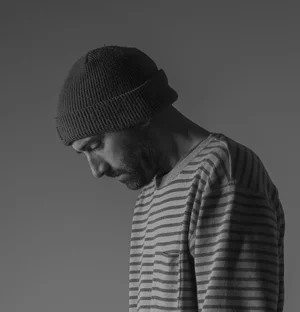
I once made a portrait with the shutter accidentally left at ¼ of a second.
I pressed the trigger, realised something was wrong and in confusion let the camera drop as I checked what I’d done.
I assumed I’d ruined the frame.
But when the negative came back, the result was something I couldn’t have planned.
The subject was still just visible. Light sources had dragged across the image. The portrait had become soft, unstable, almost ghostlike.
It was a mistake.
And I loved it.
That photograph taught me something I’ve come back to often: not every error is a failure. Some errors reveal possibilities you weren’t looking for.
That matters, because photography - and perhaps creativity more broadly - can easily become constrained by perfectionism.
Perfectionism often looks like discipline.
But often it is caution.
It keeps you close to what you already know how to do.
It produces competent work.
It rarely produces surprising work.
If you never fail, you may not be attempting anything difficult enough.
In analogue practice, failure isn’t an interruption to learning. It is part of learning.
Misjudged exposures. Awkward conversations with subjects. Prints that refuse to balance. Frames that looked promising and disappoint when developed.
None of this sits outside the process.
It is the process.
Technical problems tend to yield if you stay with them. You work through them. You learn. You adjust.
Creative failures are different. They ask more of you.
They ask whether you’re willing to take risks - not only with the camera, but with people.
Some of the biggest lessons in photography have had little to do with exposure or chemistry and much more to do with confidence. Conversation. Lowering barriers. Understanding that you can’t simply point a camera at someone and expect something meaningful to happen.
I certainly tried.
And failed.
Some of my earliest portraits were technically fine and emotionally flat. I was too hesitant. Too polite. Too unsure of what I was asking for. I mistook observation for engagement.
What I learned, slowly, was that good portraiture often asks for more than looking.
It asks for trust.
And trust rarely appears without risk.
Sometimes failure is a bad negative.
Sometimes it is discovering, too late, that you held back.
Both can teach you.
Analogue has a way of forcing a different relationship with failure because it forces patience.
There is no rushing development. No negotiating with the negative once it exists. At some point you accept that you are working with process, not controlling it absolutely.
And strangely, that can be liberating.
Once you stop demanding perfection, mistakes become information.
Sometimes they become discoveries.
Sometimes they become the picture.
There is a quiet kind of freedom in accepting that intention and accident often work together.
In fact, some of the photographs I value most began with intention - and were completed by something unexpected.
A gesture.
A shift in light.
A mistake.
A happy accident.
Failure matters because without risking it, you may never attempt anything beyond certainty.
And certainty, in photography, can be a very small place.
Notes is an ongoing record of analogue practice and community in Sheffield.